A 3 camera phone isn’t just a flashy design choice anymore; it’s become a big part of what makes a good mobile camera feel… well, actually good. If you’ve ever flipped your phone over and wondered why there are so many lenses staring back at you, you’re not alone.
The simple answer? One camera just isn’t enough anymore.
But the real answer is a lot more interesting, and once you understand it, you’ll start using your phone camera in a completely different way.
If you’re dealing with a phone screen unresponsive issue right now, don’t worry too much. This is one of the most common smartphone screen problems, and in many cases, it’s not permanent at all. Most of the time, the reason is simple, something you can really fix at home without any technical background.
Let’s move through it gradually and clearly, like we’re just sorting it out together.
It All Started With a Simple Problem
Let’s go back for a second.
Older phones had just one rear camera in phone, and while it worked fine, it had limits. You could take a decent photo, sure, but zooming made things blurry, group photos felt cramped, and low-light pictures were often disappointing.
Now think about real life. Sometimes you want to:
- Capture a wide scenic view
- Zoom in on something far away
- Take a portrait with a blurred background
A single lens can’t handle all of that perfectly. That’s where multiple lenses come in.
Instead of forcing one camera to do everything, phone makers decided to give each lens its own job and let them work together.
Meet the Cameras on Your Phone
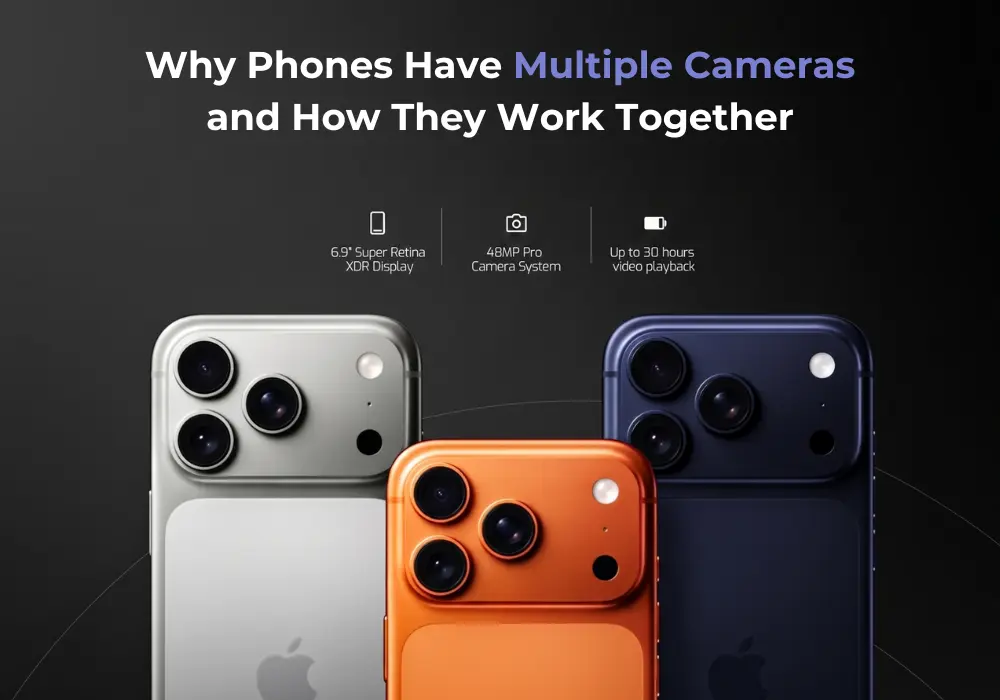
If you’re using a 3-camera phone, chances are you’ve got three main lenses. Let’s talk about them in a way that actually makes sense in daily life.
Your Everyday Lens (Main Camera)
This is your default phone camera. It’s the one that opens when you tap the camera app.
Use it for:
- Casual photos
- Food pictures
- Friends and family
It’s reliable and usually gives the best overall quality.
The “Fit Everything In” Lens (Ultra-Wide)
Ever tried taking a group photo and had to step back… and back… and back?
That’s exactly why this lens exists.
It lets you capture more in one frame, perfect for:
- Big groups
- Travel shots
- Cityscapes or nature
Once you start using it, it becomes hard to go back.
The “Get Closer” Lens (Telephoto)
Now imagine you’re at a concert or standing far from something interesting. Zooming digitally ruins the quality, but this lens fixes that.
It allows you to zoom in while keeping the image sharp.
This is one of the reasons people love a Samsung 3-camera setup; it handles zoom really well.
Bonus Lenses
Some phones, especially from Vivo or Motorola, add extra lenses like:
- Depth sensors (for portrait blur)
- Macro lenses (for super close shots)
These aren’t always essential, but they do add creative options.
The Real Magic: They Work as a Team
Here’s something most people don’t realize.
Your 3 camera phone isn’t just switching between lenses, it’s combining them.
When you take a photo, your phone quietly processes data from different lenses at the same time. It uses software (and a bit of AI) to improve the final result.
For example:
- Portrait mode uses one lens for focus and another for depth
- Night mode gathers light from multiple lenses
- Zoom transitions smoothly between cameras
So while it feels simple on the outside, a lot is happening behind the scenes.
Why iPhones Have 3 Cameras
If you’ve seen recent iPhones, you’ve probably noticed their triple-camera setup.
Apple’s idea is pretty straightforward: give users flexibility without making things complicated.
So instead of asking you to pick the perfect lens, the phone quietly adjusts for you. Whether you’re zooming, switching angles, or taking portraits, everything feels smooth and natural.
That’s why many people describe the iPhone phone camera as “effortless.” It just works.
Which Samsung Phone Has the Best Camera?
Samsung has taken things even further, especially with its high-end models.
If you’re looking for a good mobile camera, Samsung’s Galaxy S series, particularly the Ultra versions, is often considered among the best.
They’re known for:
- Strong zoom performance
- Sharp image quality
- Great low-light photography
The Samsung 3 camera setup (and beyond) gives users more control and more creative options.
What Actually Makes a Good Mobile Camera?
Let’s put it in actuality, it’s not just about having more lenses.
A good mobile camera explains how fine everything works together.
Here’s what actually matters:
- Clarity: Are your photos highlighted and focused?
- Lighting: Does the camera capture sharp and dark scenes equally?
- Color accuracy: Do pictures’ visage naturally?
- Ease of use: Can you just focus and capture without overthinking?
The ideal phones harmonized all of these things, not only the number of multiple lenses.
Different Brands, versatile Styles
Even though Apple, Samsung, Vivo, and Motorola all have many cameras, they each have their own particular feature.
- iPhone: Clean, natural photos and smooth performance
- Samsung: Bold colors, powerful zoom, lots of features
- Vivo: Strong portrait shots and beauty-focused results
- Motorola: Simple, reliable, and budget-friendly
So the “best” phone camera really depends on what you personally like.
Are More Cameras Always Better?
Honestly? No.
It’s casual to suppose that more lenses mean improved photos, but that’s not always right. A well-optimized 3 camera phone can easily outperform a phone with more cameras but weaker software.
So instead of asking “how many cameras,” it’s better to ask:
- Does it take good photos in real life?
- Is it easy to use?
- Does it suit your needs?
That’s what actually matters.
Why This Matters More Than You Think
At the end of the day, your phone camera is probably the camera you use the most.
You use it to:
- Capture memories
- Share moments online
- Record videos
- Save important things quickly
And thanks to multiple lenses, your phone adapts to whatever you’re trying to do, without you needing to be a photography expert.
Are More Cameras Always Better?
Honestly? No.
It’s casual to suppose that more lenses mean improved photos, but that’s not always right. A well-optimized 3 camera phone can easily outperform a phone with more cameras but weaker software.
So instead of asking “how many cameras,” it’s better to ask:
- Does it take good photos in real life?
- Is it easy to use?
- Does it suit your needs?
That’s what actually matters.
Why This Matters More Than You Think
At the end of the day, your phone camera is probably the camera you use the most.
You use it to:
- Capture memories
- Share moments online
- Record videos
- Save important things quickly
And thanks to multiple lenses, your phone adapts to whatever you’re trying to do, without you needing to be a photography expert.
FAQs
Q1: Which Samsung phone has the best camera?
Q2: Why does iPhone have 3 cameras?
Q3: What are the different cameras on your phone for?
Q4: How do the three cameras of my phone work together?
Q5: What do the different cameras on a phone do?
Final Thoughts
The rise of the 3 camera phone is really about making photography easier, smarter, and more flexible.
Instead of relying on a single rear camera in a phone, today’s devices use multiple lenses to handle different situations, and they do it in a way that feels natural and effortless.
Whether you’re using an iPhone, Samsung, Vivo, or Motorola, one thing is clear: having a good mobile camera today means having a system, not just a lens.
And the best part? You don’t need to understand all the technical details to enjoy it.
Just open your camera, take the shot, and let your phone do the rest.